Writing Residency
Faculty Writing Residency
About the Residency
Since 2006, this annual five-day writing retreat has catalyzed faculty writing about the Scholarship of Teaching and Learning (SoTL). Participants meet for four consecutive days at the start of the summer to write and to exchange feedback on drafts. Balancing dedicated time for faculty writing with small group feedback on drafts, these intensive summer retreats help faculty make the crucial, and often difficult, step of going public with their SoTL research.
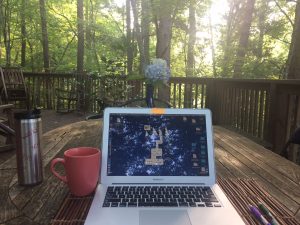 We welcome from faculty writers at any stage of their writing projects���from beginning ideas to completed drafts. Applicants, however, must be available for all five days to focus on their writing and must be working on projects that they can further develop through the residency activities (dedicated time/space for writing and daily feedback from colleagues).
Residency participants meet daily in small groups, and as a whole group on the first and last day of the residency. This year’s residency will be located on campus.
The 2026 Writing Residency is scheduled for Monday, June 8th – Friday, June 12th, 2026. are due by 5pm on Monday, April 20th, 2026. Applicants will be notified of their acceptance the week of May 4th, 2026.
For more information about the residency, contact油Jill McSweeney.
Residency Outcomes
To date, approximately 65% of Faculty Writing Residency participants have published their residency projects in peer-reviewed publications. (Faculty looking for publication venues for their SoTL projects can review油this list of SoTL Journals.) Beyond publication outcomes, the residencies have helped faculty fine-tune their writing habits, connected colleagues from across campus for ongoing writing groups, and inspired participants��� renewed motivation to pursue SoTL research agendas.
Past participants have said:
���I was astounded at how rich and helpful the feedback was ��� not just from the facilitator, but from each group member. My progress was so accelerated!���
���The writing residency helped by providing a quiet and peaceful place to draft and positive peer pressure to produce each day.���
���I油am so grateful for the Writing Residency. It dispelled my fears about publishing my research and gave me a safe place油to explore the possibilities at hand. My team became a network of support and immediate feedback. The Writing Residency was truly a transformative time for me in my career and油I am so grateful.���
Sample Publications by Participants:
Adamson, S. (2012). .油The Language Educator, 7(2).
Adamson, S. (2012).油.油The French Review,油85(5), 879���885. http://www.jstor.org/stable/23213979
Auman, C.油(2011). .油College Teaching,油 59(4), 154-161. https://doi.org/10.1080/87567555.2011.602134.
Bitting, K. & Merricks, J. (2024). . Environmental Education Research, 1-19.
Depro, B. (2022). .油International Review of Economics Education, 39(March), 100230. https://doi.org/10.1016/j.iree.2021.100230.
Carpenter, JP. (2015).油.油Contemporary Issues in Technology and Teacher Education,油15(2), 209-234.
Carpenter, JP. (2014). .油International Journal of Social Media and Interactive Learning Environments, 2(2), 103-118,油DOI:油10.1080/87567555.2011.602134.
Felten, P., Moore, J., & Strickland, M. (2009).油.油Journal on Centers for Teaching and Learning, 1(1), 39-56.
Hall, E.油 & Meinking, K. (2023). Triangulating Trust: Instructor Integration of Ungrading and Co-creation in Teaching and Learning as an Indicator of Vulnerability in the Classroom. Center for Engaged Learning.
Holmes, A. (2009).油.油Reflections: Writing, Service-Learning, and Community Literacy,油8(3), 76-98.
Isaac, M. (2012)..油English Journal, vol. 101, no. 4, 2012, pp. 83-89.
Kearns, L. (2010).油.油Journal of Dance Education, 10(2), 35-40.
Kupatadze, K. (2018). .油Teaching and Learning Together in Higher Education, 1(24), 1-10.
Myers, J. & Festle, M. J. (2007).油.油Journal of the National Collegiate Honors Council, 8(2), 57-66.
Palfy, C. (2019). .油The Routledge Companion to Music Theory Pedagogy, 1(55), 376-381.
Patch, P.油(2018).油.油National Council of Teachers of English.
Peters, T. (2012). .油Journal for Cultural and Religious Theory, 12(2), 215-227.
Pyne, K. (2012).油.油Educational Leadership, 1(69), 1-16.
Pope-Ruark, R. (2011).油.油International Journal for the Scholarship of Teaching and Learning, 5(1), Article 6,油https://doi.org/10.20429/ijsotl.2011.050106
Russell, A. (2010).油.油International Journal for the Scholarship of Teaching and Learning, 4(2), article 25, https://doi.org/10.20429/ijsotl.2010.040225.
Shively, K. (2018)油.油The Players’ Journal.
Train, T. & Miyamoto, Y. (2017).油.油Journal of College Science Teaching, 46(4), 76-83.
Udeh, I. (2020). .油e-Journal of Business Education & Scholarship of Teaching, 14(1), 90-118.
von Briesen, E. (2023)
Writing Importance and Skills in an Advanced Computer Science Course, Journal
of Computing Science in Colleges, 39(5), 119���128.
Wente, A. (2019).油.油Journal of Music Theory Pedagogy, 33, 233-252.
Windham, S. (2017). .油Die Unterrichtspraxis/Teaching German, 50(1), 79���90.
To view sample SoTL publications by participants in CATL programs, visit our SoTL publications page.
Note to Writing Residency Alumni: We love celebrating your accomplishments. Please油email油us your citations so that we can add them to this list.