


Geoffrey Lynn ’07 hopes to bring benefits to cancer patients and their families with a new personalized cancer vaccine.
By Roselee Papandrea
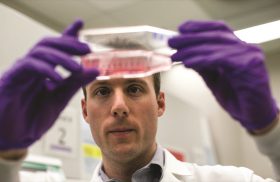
If all goes as expected, Avidea Technologies, a company that biomedical scientist Geoffrey Lynn ���07 co-founded in Gaithersburg, Md., will begin clinical trials of immunotherapies as a treatment for patients with advanced cancers.
The company���s lead product���a personalized cancer vaccine that Lynn co-developed with colleagues at the National Institutes of Health, University of Oxford and the Institute of Macromolecular Chemistry���will be tested on patients this year. ���Entering clinical trials is a major milestone for the company,��� Lynn says. ���We are hopeful we will see strong immune responses in patients, which could be an early sign that our approach could be effective for treating cancers.���
It���s not the first cancer vaccine ever proposed, and it���s still too early in the process to even call it ���groundbreaking.��� But Lynn, who started doing research when he was a first-year student at 消消犯, is confident in the product���s potential. Early data generated by Lynn and his colleagues has shown promise in preclinical studies. Lynn remains grounded in the science and is taking it one step at a time. ���It���s good for us to be skeptical,��� he says. ���No matter what the early studies show, you have to make sure it works in patients because that���s ultimately the people we are trying to benefit.���
Chemotherapy is the most common treatment for cancer. The drugs used to eradicate the fast-growing affected cells are toxic to healthy cells, so the treatment often has devastating side effects for the patient. The vaccine Avidea is developing would be specific to an individual���s tumor, with a unique vaccine for each patient. ���One potential benefit of immunotherapy is that you can leverage the patient���s own immune system to specifically recognize cancer cells while leaving healthy cells intact,��� Lynn says. ���This targeted approach is potentially safer and more effective than many chemotherapies that destroy both healthy and cancerous tissues.���
Avidea���s personalized cancer vaccine works by generating immune responses to mutations that spontaneously arise in cancers. As a cancer progresses it accumulates many such mutations, referred to as neoantigens. These neoantigens are present only in cancer cells and are unique to each individual. The problem is most people don���t have an immune response that can fight those neoantigens. Avidea is developing individualized vaccines that offer a safe and potent approach to generating immune responses against neoantigens as a means to eliminate cancer cells.
���In the last several years, there has been tremendous progress in immuno-oncology,��� Lynn says, which makes the timing of Avidea���s vaccine ideal. ���Patients who had survival rates of only a few months with aggressive cancers are now surviving for years after treatment with some immunotherapies. That is certainly a tremendous improvement for some patients and their families, but current immunotherapies don���t work for all patients. We���re hopeful that Avidea���s personalized cancer vaccine can improve the proportion of patients who respond well to immunotherapies.���
Lynn, an Elon College Fellow who majored in chemistry, was always aware that he wanted his work to help people���and affect public health���but he didn���t envision developing cancer therapy, he says. Reflecting back, it���s clear each step he took along the way led straight to this career path. ���My experiences at Elon were pivotal to bringing me to where I am today,��� he says.
More than 15 years ago when Lynn took his first chemistry class in high school, he was hooked. Chemistry made logical sense to him. Likewise, on his first day of Chemistry 111 at Elon, he knew it wasn���t the class for him. Joel Karty, the associate professor of chemistry who taught that class and later served as Lynn���s mentor, remembers their first conversation. After Karty���s first lecture, Lynn told him he didn���t belong in that class. If the then-first-year Lynn couldn���t handle the lowest course for science majors, there wasn���t a lot Karty could do for him. But what Lynn needed was something more challenging.
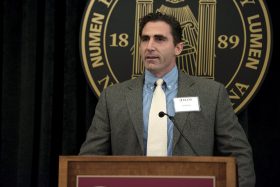
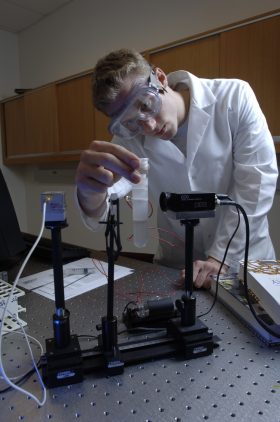
���That was the beginning of a special journey for Geoff,��� Karty recalled as he introduced Lynn at the 2016 Distinguished Alumni Awards Ceremony held during Homecoming in October, where Lynn was recognized as the Young Alumnus of the Year. ���We immediately got him switched to an advanced general chemistry course.��� That same week, Lynn expressed an interest in research and started doing 消消犯 research on nanoparticles with Karty that spring.
It was one of many unique paths Lynn was to take during his Elon career. In his sophomore year, he was the first Elon student to earn the prestigious Goldwater Scholarship, a program honoring former U.S. Sen. Barry Goldwater that fosters and encourages outstanding students to pursue careers in the fields of math, the natural sciences and engineering. Elon faculty had unsuccessfully nominated students for the scholarship in the past. ���Winning the Goldwater Scholarship was instrumental in something very important, not only in Geoff���s career but to Elon,��� Karty said. ���In the years since, we���ve had a couple winners and honorable mentions. What Geoff was able to do was really put Elon on the Goldwater Scholarship map. What he did was pave the way for other Elon students to follow in his footsteps and have great success.���
Lynn���s 消消犯 research was a boon to receiving the scholarship because it focused on targeted drug delivery, and an immunology class he took with Yuko Miyamoto, associate biology professor, seamlessly tied the chemistry and biology together. Through funding from the National Science Foundation, he also spent a summer developing medical applications of nanoparticles at the University of Notre Dame.
���I never planned to work in biotech or on cancer vaccines,��� Lynn says. ���It just all came together. It continues to refine. I continue to build on things. My interest in chemistry and immunology came together at Elon and drove me to my Ph.D. project and ultimately led me on this path.���
In his senior year at Elon, Lynn was awarded a National Science Foundation Graduate Research Fellowship Award. It allowed him to do research at the NIH and earn a doctoral degree at the University of Oxford in England. Parallel with that, Lynn was accepted into an M.D./Ph.D. program at Johns Hopkins University. Lynn pursued combined medical and doctoral degree training between Johns Hopkins and Oxford as an NIH Oxford-Cambridge Scholar. He spent two years in medical school and the next four earning his doctorate in biomedical engineering.
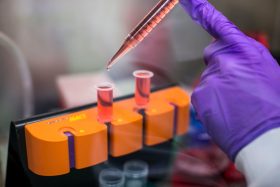
The NIH experience made him aware of the challenges associated with cancer vaccines. ���Working at the vaccine research center gave me exposure to a lot of different vaccine technologies and an understanding of how they work and why they fail,��� Lynn says. ���I saw a lot of problems with existing technology and being a chemist, I saw ways to overcome some of the challenges.���
Lynn was on track to return to Johns Hopkins to finish his last two years of medical school but the work temporarily took him in a different direction after he co-founded the biotechnology company. ���I want to get the company further along and then I will finish medical school,��� he says.
His research has led to several patents and high-impact publications on vaccines, including two recently published in Nature Publishing Group journals. For now, Lynn refers to himself as Avidea���s chief scientific officer as he moves to get the vaccine into clinical trials, but he plans to eventually return to the place where he is most comfortable. ���It���s been a great experience, oftentimes humbling, but I���m looking forward to the day I can return to the laboratory and just be a scientist again,��� he says. ���Though, my biggest hope is that what we���re doing will actually benefit patients one day and so I���m eager to continue doing whatever it takes to get us there.���