History of the Honors Fellows Program
The History of the Honors Program
Origins of Honors at Elon (1965–1979)
The earliest form of honors education at Elon began in 1965, when a small honors program of 36 students was first mentioned in the Maroon and Gold.
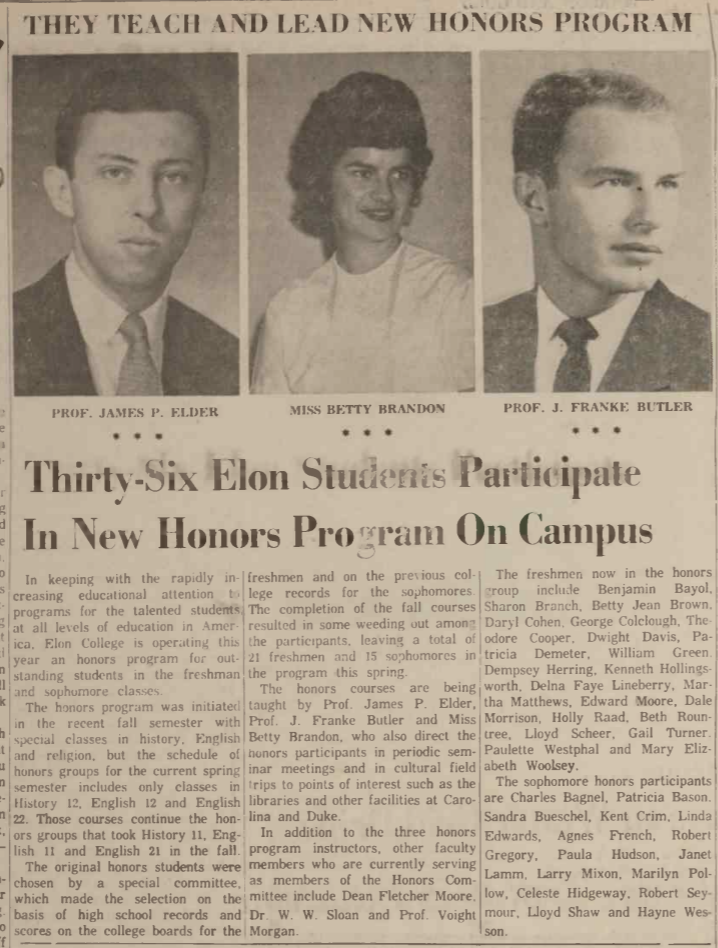
Honors Program Introduction in the Maroon and Gold 1965
In 1974, The officially titled “Honors Program” was designed to allow students to “work ahead at an accelerated rateâ€� while engaging in challenging academic experiences. The program was developed by a faculty committee that included Dr. J. Earl Danieley, Dr. Robert Blake and Dr. George Troxler, and was chaired by Dr. John Sullivan.
Dr. Anne Ponder served as the program’s first director. Initially, the program was open only to sophomores, juniors and seniors and emphasized interdisciplinary honors courses and academically challenging learning experiences
One of the first honors courses, “Fact & Value,� launched in 1976 with a small cohort of 10 students. By the late 1970s, Elon faculty were actively working to expand honors offerings and were participating in national conversations about honors education through conferences such as the National Collegiate Honors Council.
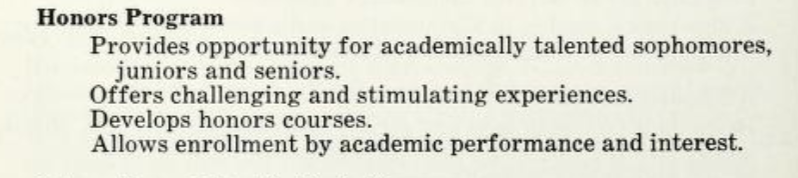
Honors Program Mentioned in the Bulletin of Elon College, 1974-1979
Growth and Recognition (1980–1990)
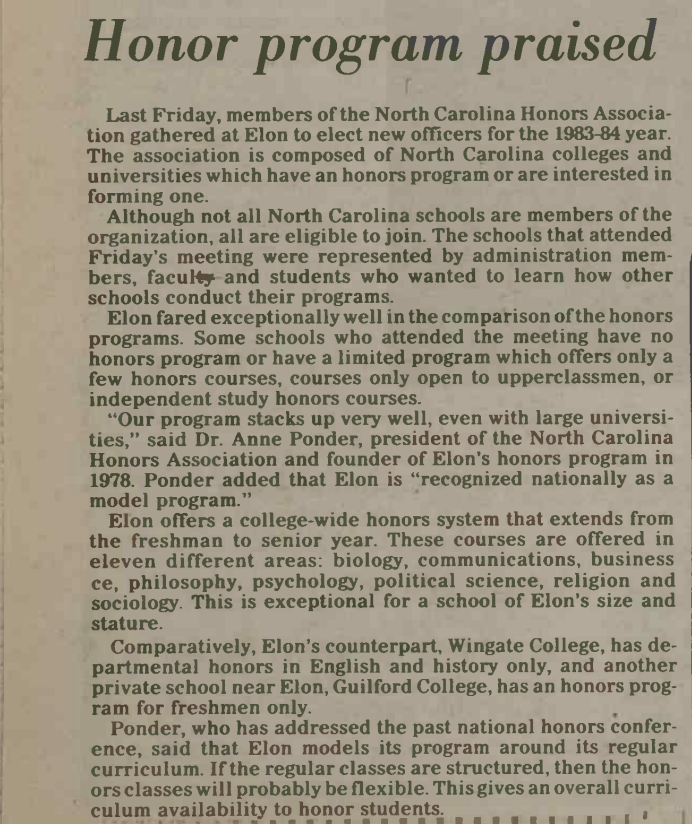
Honors Program Praised in The Pendulum, 1983
During the 1980s, the Honors Program expanded both academically and institutionally.
In 1983, the program was praised by the North Carolina Honors Association and was described as being “recognized nationally as a model program,� according to founding director Anne Ponder.
Honors courses were offered in more than eleven academic areas, and students became increasingly visible leaders on campus. Many honors students served as Student Government Association officers, editors ofÌý°ä´Ç±ô´Ç²Ô²Ô²¹»å±ð²õ, varsity team captains and student organization leaders.
In 1985, Dr. Lamar Bland became director of the program following Ponder’s resignation. During this time the program became more standardized and strengthened its interdisciplinary approach.
By the late 1980s, the program had also introduced the idea of a senior research experience, which would later become a central element of the honors curriculum.
Expanding the Honors Community (1991–2001)
In 1991, Dr. Kathy Lyday-Lee became director and expanded the program’s intellectual and community-building opportunities. The program enrolled between 80-125 new students each year. As the program and the university evolved, more Fellows programs were initiated, and the Honors Program became smaller and more competitive.
Several new initiatives were introduced during this period, including:
-
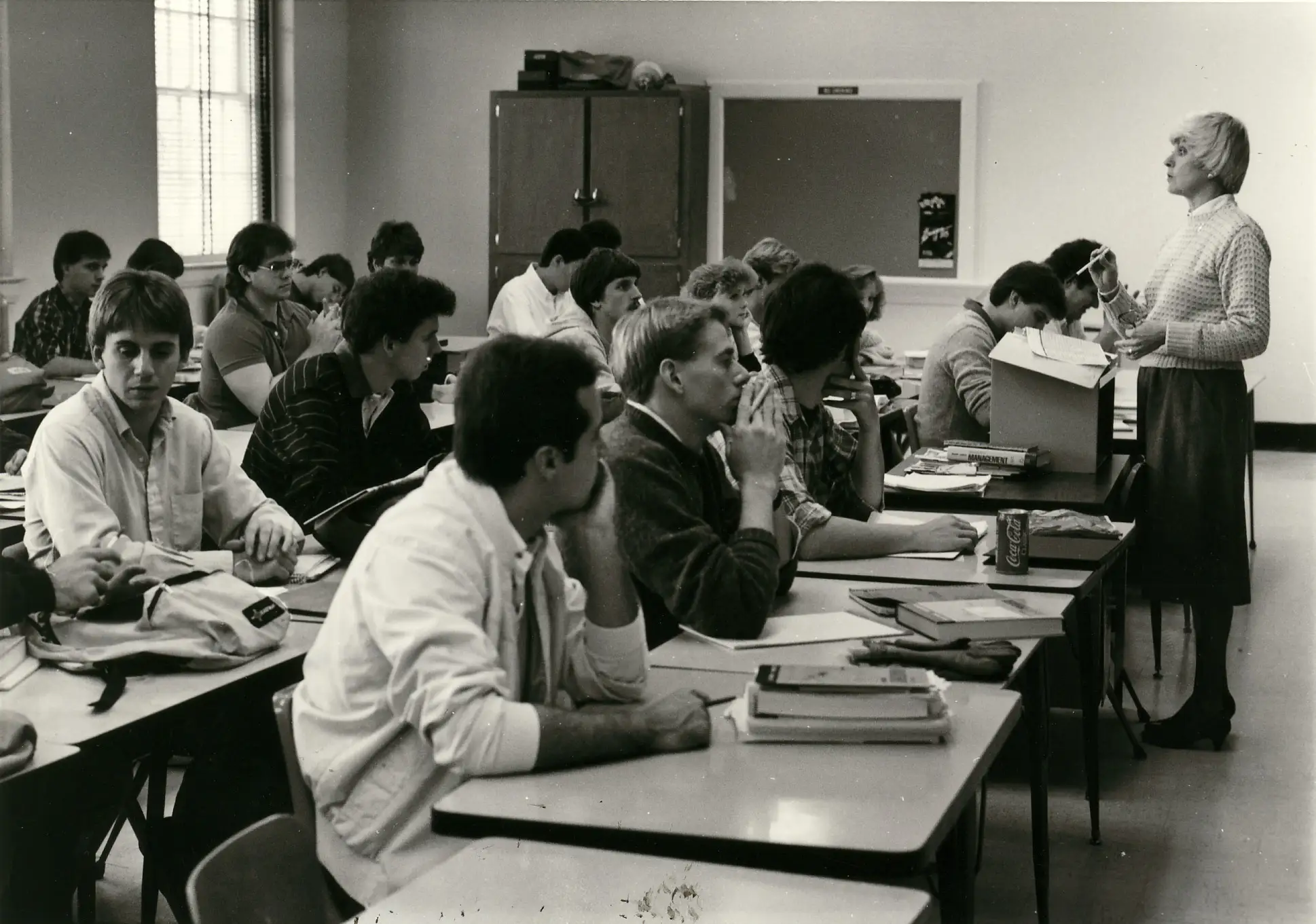
An ¾Ã¾ÃÈÈ Classroom in 1994
Honors Flash, a student-led newsletter
- Faculty-student programs such as “Evenings with Faculty” and “Travels with Faculty”
- The “Backdoor Ethics� discussion series
- First year overnight retreat near Hanging Rock where they learned about the program
- Junior retreat in Williamsburg to help them explore graduate school options, writing resumes, and grad school applications
- A chapter of the International Honor Society, Phi Kappa Phi, was chartered at Elon
Honors courses during this period included Honors sections of Elon 1010, first year writing, and global. ¾Ã¾ÃÈÈ in Honors Literature of the Holocaust and Honors Philosophy of the Holocaust were among the first groups to tour the US Holocaust Museum in Washington, DC!
This period also saw the creation of the Student Undergraduate Research Forum with help from Academic Dean Dr. Rosalind Reichard.
In 1995, the university launched the Elon College Convocation for Honors, an annual event celebrating academic achievement, community engagement and philanthropy. During this period, honors students made up 5% of the graduating class. The first convocation speaker was former Prime Minister of the United Kingdom,
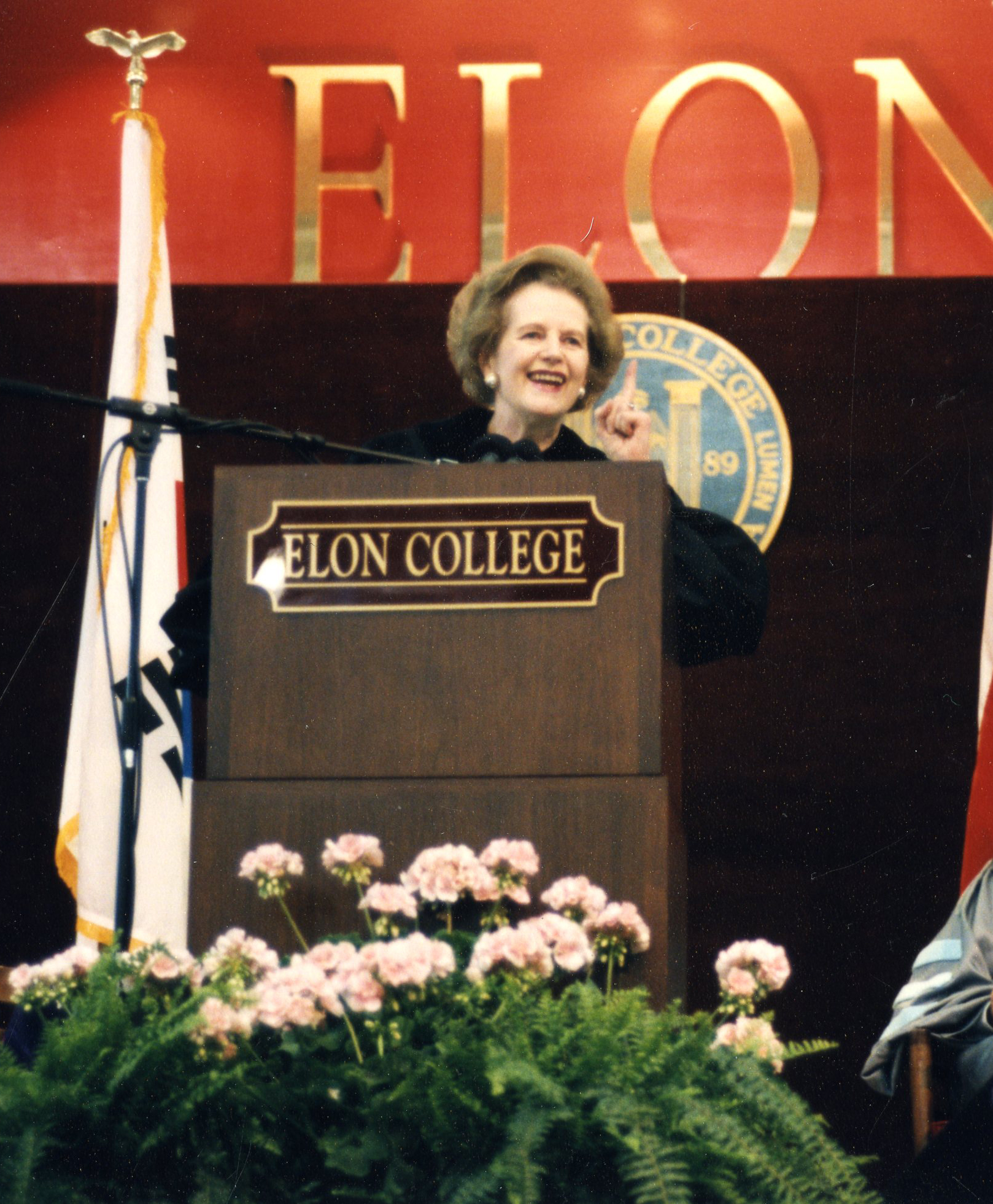
Margaret Thatcher Speaking at Honors Convocation, 1995
Subsequent speakers included:
- Former President, (2001)
- English Primatologist & Anthropologist, Jane Goodall (2002)
- South African Bishop & Theologian, (2003)
- Astronaut & Former Senator, John Glenn (2005)
- Former Secretary of State, Colin Powell (2006)
By the mid-1990s, the program included honors housing in Virginia and Chandler, travel opportunities, research funding and a structured honors curriculum.
Honors students increasingly presented at professional meetings beyond Elon, as the school remained a member of the N.C Honors Association, Southern Regional Honors Council, and National Collegiate Honors Council.
Restructuring the Fellows Program (2001- 2007)
In 2001, Dr. Daniel Wright became director of the Honors Program as the university expanded recruitment of high-achieving students.
The program underwent a major restructuring beginning in 2002. Admissions were reduced from approximately 80 fellows to about 40 per class in order to strengthen the academic experience and the sense of community. At the same time, financial support for fellows increased significantly, with annual scholarships reaching $9,500 beginning in 2003.
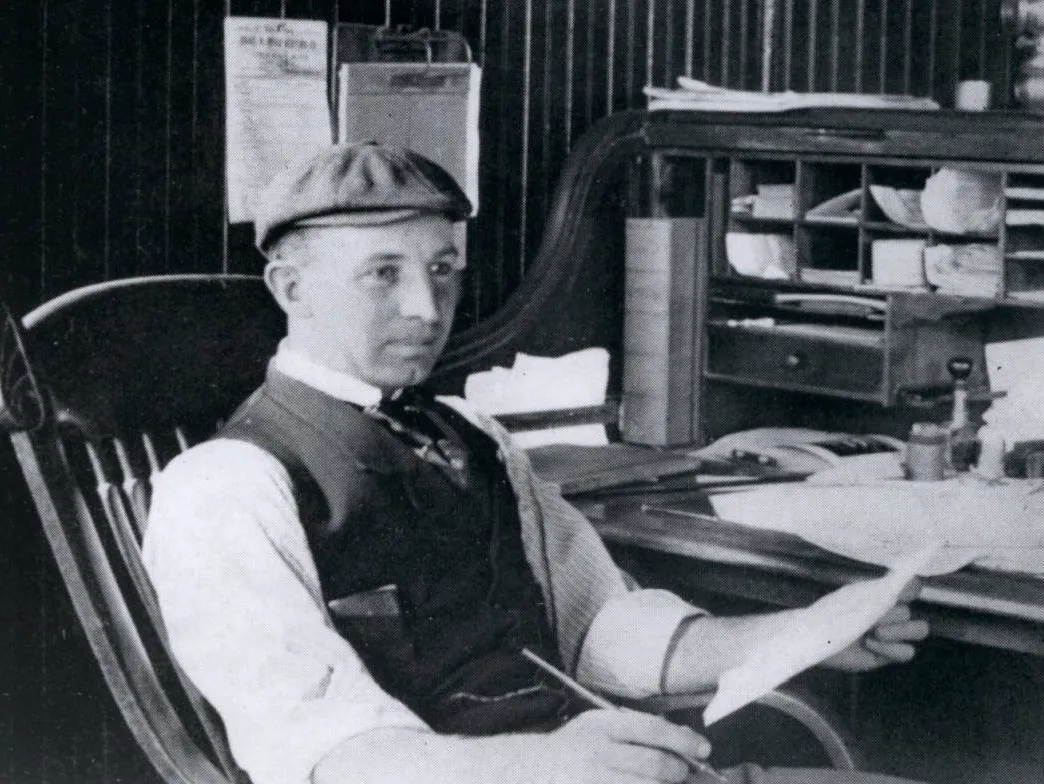
William R. Kenan Jr. (1873-1965) courtesy of UNC digital libraries photographic archives
This period also saw the creation of the William R. Kenan Jr. Honors Fellows Scholarship, a four-year full-tuition award for the top entering honors fellow each fall.
The restructuring introduced several defining elements of the modern honors curriculum, including:
- First-year honors seminar in a discipline
- Two second-year multidisciplinary seminars
- Global experience courses
- A formal honors thesis requirement
In 2003, Dr. Mary Jo Festle took over Wright’s position as director, working alongside associate director Janet Myers until 2008. The pair oversaw more of the development of the courses and creation of the entire thesis process.
The first Fellows to complete a thesis were asked to reflect on the process. One wrote,
“These lessons that I have learned are a whole lot deeper and meaningful to life than I ever thought I would gain from working on a research paper. But I have found that this thesis is much more than a research paper, because when you put your effort and heart into a project combined with others, it takes on so much more significance.�
As associate director, Dr. Myers also began coaching Fellows who were interested in applying for very competitive national and international fellowships, such as the Fulbright, Rotary, Goldwater, and Truman. This was the precursor to the university’s current office, which serves any talented Elon student, not just Honors Fellows.
Also in 2003, the Honors Pavilion, commonly known as the “Billy House,â€� was dedicated as a space for the honors community. The newly constructed William R. Kenan, Jr. Honors Pavilion, which along with a learning community in 3rd floor Virginia, housed Fellows and a faculty advisor. ¾Ã¾ÃÈÈ promptly nicknamed the building “Billy Houseâ€� after Kenan, who donated generous gifts to support scholarships for Honors Fellows.
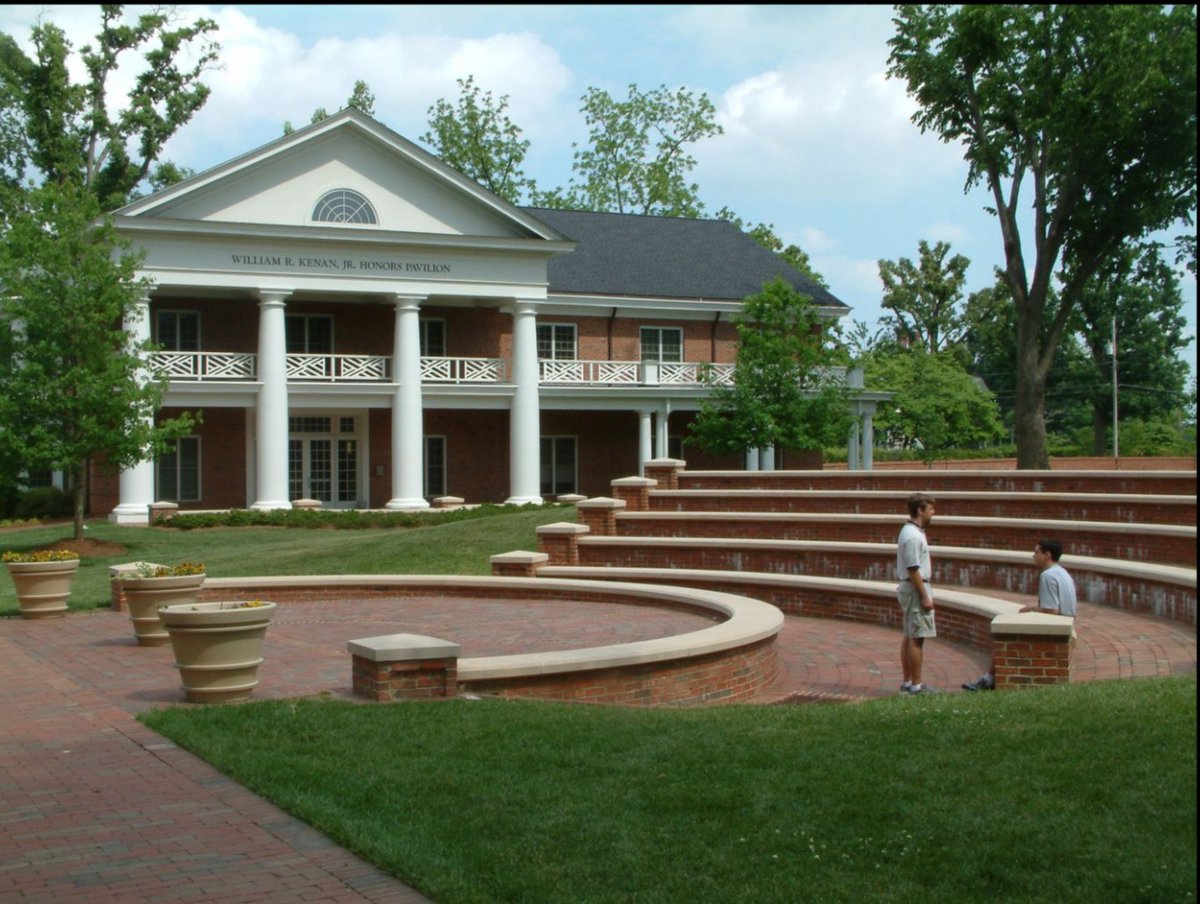
William R. Kenan Jr. Honors Pavilion
One student observed that it was a great place to live:
“The family dynamic of Billy House is amazing. Every person in the community is a unique individual, and these personal differences are recognized. We each have our own lives . . . but at the end of the day we are a family.�
In the fall of 2007, the Festle and Myers wrote an essay for The Journal of the National Collegiate Honors Council titled “
Building the Modern Honors Program (2008–2016)
In 2008, Dr. Maureen Vandermaas-Peeler became director of the Honors Program, with Dr. Mike Carignan serving as associate director. The program continued expanding opportunities for experiential learning and global engagement.
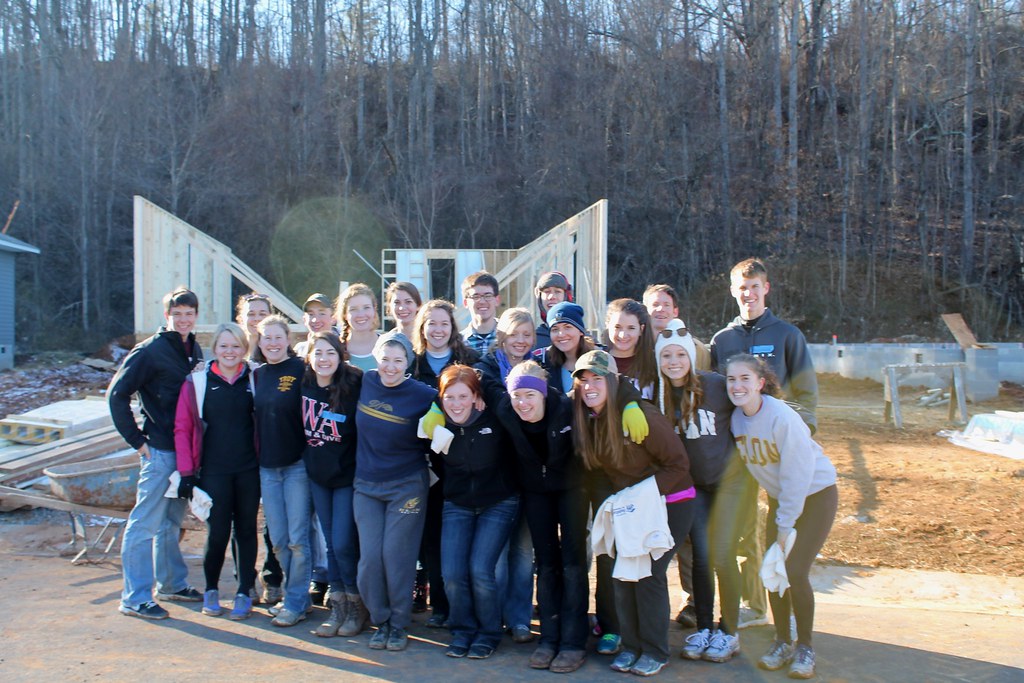
Honors Service Trip to Asheville, 2014
New initiatives included:
- An Honors Fellows Community Director position (HFCD) starting in 2012
- A first-year honors service trip to Asheville beginning in 2012
- A winter-term study abroad program in Türkiye for first-years beginning in 2013
This period was characterized by study and research on mentoring ¾Ã¾ÃÈÈ research. Vandermaas-Peeler co-led a CEL research seminar on “Excellence in Mentoring Undergraduate Researchâ€� with Paul Miller and two external faculty that resulted in
Carignan worked with Dr. Tom Mould to develop a Teaching in Honors workshop in partnership with CATL that enhanced faculty development at Elon. The workshop was demonstrated at the National Collegiate Honors Council conference and the pair were subsequently invited to run the workshop for other honors programs nationally and internationally.
Leadership of the program continued to evolve, with Dr. Tom Mould serving as director beginning in late 2013 and Dr. Barbara Miller Gaither becoming associate director in 2014.
In 2016, the Honors Advisory Committee expanded faculty involvement by extending committee terms from two years to three.
Honors in the Present Era (2017–Present)
The program entered a new era of growth beginning in 2017 when Dr. Lynn Huber became director of the Honors Program.
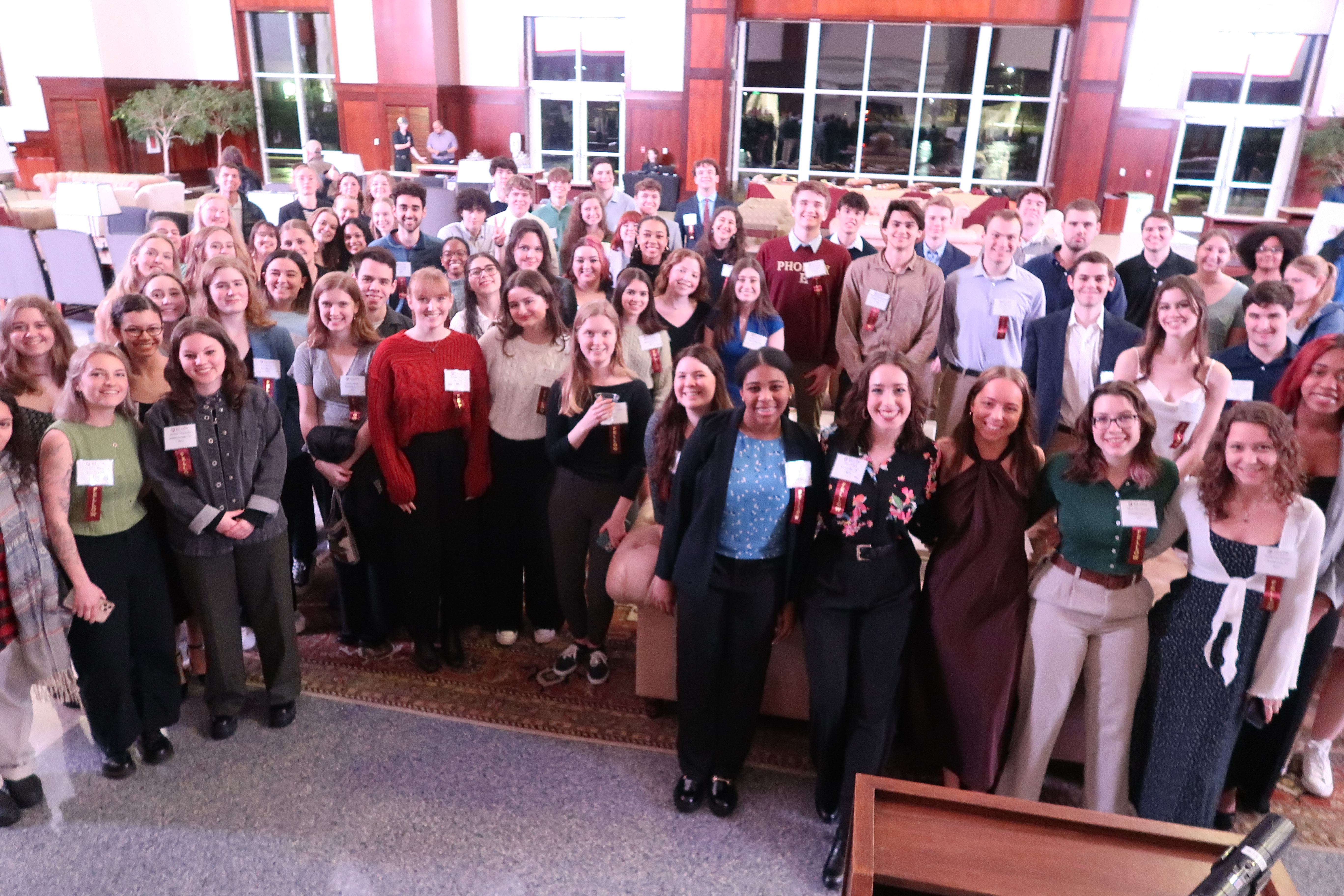
Elon Honors Fellows at Fellows Weekend, 2024
In 2018, the program created the Honors Diversity and Inclusion Director (HDID) student leadership position to support initiatives that foster an inclusive community for students from historically marginalized backgrounds.
In 2021, Dr. Steven Bednar became director, working alongside Associate Director Dr. Baris Kesgin. In his term, Dr. Bednar oversaw a period of program expansion.
In 2023, the size of the honors cohort increased from 45 to 60 fellows per class. Faculty representation on the Honors Advisory Committee also expanded in 2025 to support the program’s continued growth.
In 2026, Dr. Svetlana Nepocatych was appointed director of the Honors Program alongside Associate Director Dr. Brandon Sheridan, beginning a new chapter in the program’s leadership and development.