


Elon鈥檚 band, choral and orchestra directors are going beyond recommended safety guidelines to find ways to make music this semester.
Carrying trumpets, clarinets and saxophones, they line up regimented and masked six feet apart at the practice field behind the Center for Health and Wellness on a blistering recent Wednesday afternoon.

One by one, these musicians descend onto the field, receive a liberal squirt of hand sanitizer and slip black fabric covers onto their horns and bells. They march by section toward opposite ends of the field 鈥� clarinets and saxophones to the east, trumpets to the west 鈥� where they place themselves on painted red marks 18 feet apart. Horns raised on signal, they begin the fight song. Thirty minutes later, they’re off the field.
This is Fire of the Carolinas practice during COVID-19. If it sounds like a lot more work than usual, that鈥檚 because it is. But it still sounds like music.
鈥淲e have to have this structure in order to ensure students鈥� safety,鈥� said Director of Bands Jonathan Poquette.
The presence of an airborne virus complicates every aspect of life but poses a particular set of problems for choirs and music ensembles. By definition, they bring large numbers of people together in the same space to expel large amounts of air singing and blowing instruments.

For Elon鈥檚 choral and ensemble directors, the challenges were clear: How can we continue making music together 鈥� as safely as possible 鈥� and maintain a valuable learning and community experience? The solutions came through ingenuity, patience, and meticulous attention to process.
Poquette and Assistant Director of Bands Ben Jones created a safety plan over the summer they anticipated would work for rehearsals. After the first practice, they found gaps and reassessed for additional, minute safety guidelines.
鈥淥ne of the things that makes this whole season of COVID difficult is that we can plan as much as we want and as hard as we can, but as soon as students get there, those plans might have to change,鈥� Poquette said. 鈥淲e鈥檙e doing everything we can to make sure we鈥檙e giving students the opportunity to play in band, but we have to do it safely. That鈥檚 first and foremost.
鈥淚f we can鈥檛 do it safely, we鈥檒l go virtual.鈥�

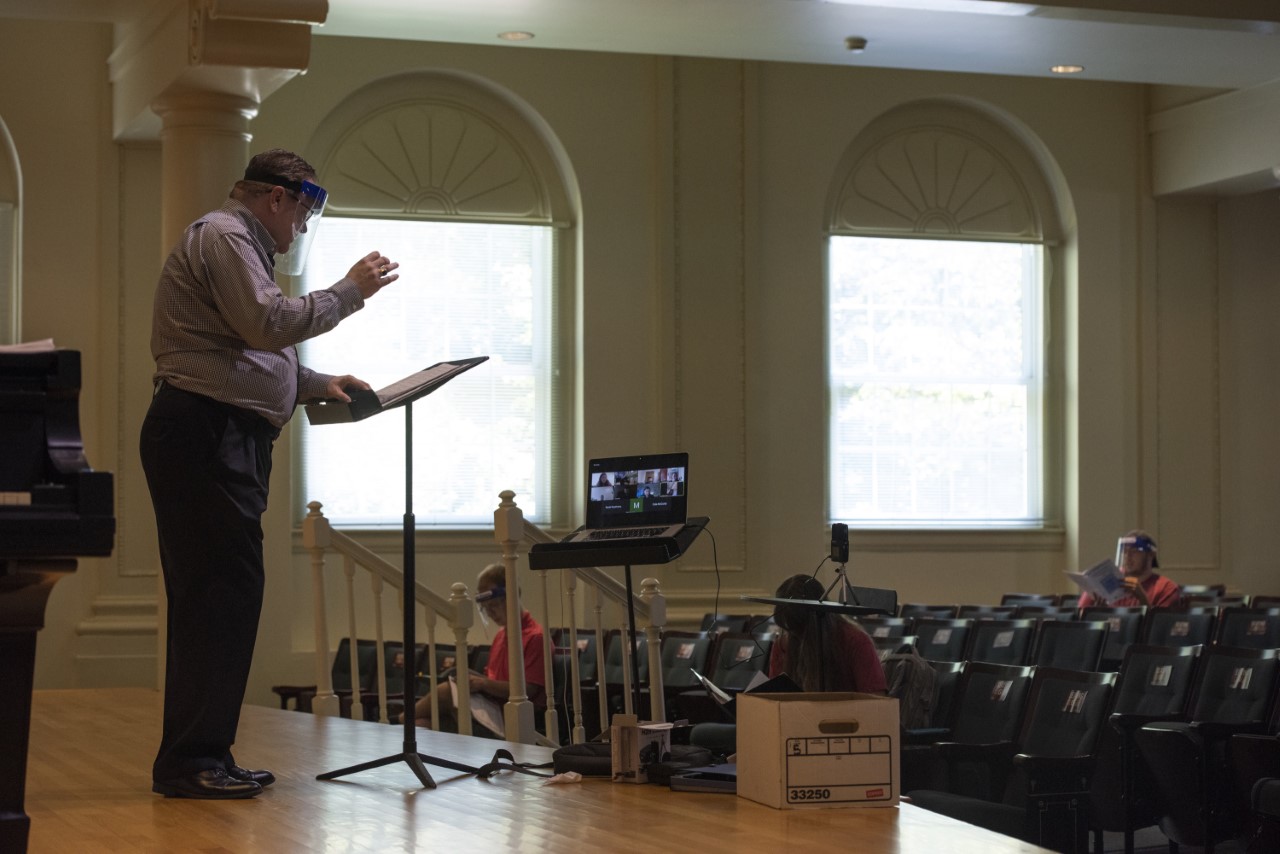
In Whitley Auditorium, half of the members of Elon鈥檚 Camerata are scattered throughout the auditorium seating, sopranos to the left, altos center, basses and tenors on the right. All are wearing face shields and standing about 15 feet apart (greater than the 10-12 feet recommended by national choral associations). Director Stephen Futrell stands alone at the edge of the stage conducting. A few feet beneath him, a chorus member monitors the other half of Camerata鈥檚 members tuning in and participating via Zoom.
鈥淲e鈥檙e still able to meet our goals and objectives鈥� learning vocal technique, vocal health, and the study of musical literature, composers and styles, Futrell said.
They are rehearsing for the annual holiday program. Camerata鈥檚 usual rehearsals are 70 minutes long, but have been cut to 35-40 minutes to reduce the amount of time members are in the room together. Futrell expects this year鈥檚 program 鈥� which will stream online 鈥� will also be cut from 75 minutes to about 40 minutes for the same reason.
Futrell spent the summer planning and revising those plans to create a detailed schedule of rehearsals and groupings. The course鈥檚 syllabus is broken down by day, detailing who sings where and when. He hopes to have the selected pieces learned by fall break so they can spend the final weeks of rehearsal on technique and musicality.

鈥淭he silver lining is that I鈥檓 usually organized, but I鈥檓 especially organized this semester,鈥� Futrell said. 鈥淚t鈥檚 like running the mile in track and field. The first lap or two, you set your pace. The third lap, you cruise if you can, and then you burn the last lap. We鈥檙e cruising to Fall Break, so we can review afterward.鈥�
Professor of Music Thomas Erdmann said the 久久热 Symphony Orchestra is rehearsing in modified ways and has plans to perform this fall. 聽Senior Hannah Strickland 鈥�20 plays violin in the orchestra. The orchestra now consists of strings, and students are spread about 14 feet apart along the band room risers for rehearsals inside the Center for the Performing Arts.
Though 鈥渄isorienting鈥� for the musicians’ ears and timing 鈥� they鈥檙e used to playing elbow to elbow simultaneously 鈥� Strickland said she was grateful to be able to be part of the ensemble, to see and play music with friends, and to continue the symphony orchestra during strange times.
There was a similar sentiment around the marching band鈥檚 practice that hot afternoon.
The camaraderie among musicians still exists, because the love of making music together 鈥� of 鈥渂eing able to band,鈥� as Poquette put it 鈥� exists regardless of constraints.
Elon鈥檚 concert band is rehearsing similarly to the marching band, rotating in and out of large outdoor tents, spaced apart, covers over all horns. The marching band has essentially become a pep band as sections rehearse separately, without learning marching routines normally performed on football fields.

鈥淭here鈥檚 an interesting opportunity to get the community to see that marching band isn鈥檛 directly related to athletics,鈥� Poquette said, referencing the possibility of physically distanced performances in large outdoor spaces later this fall. 鈥淲e鈥檙e a part of the music curriculum, and we鈥檙e using marching band as a training ground for future music educators.鈥�
鈥淩ight now, let鈥檚 keep students safe. Once we鈥檙e confident in that, then we can take it out and hopefully play at various venues.鈥�