Women in Myth and Their Stories Retold: A Beginner’s Guide to Medusa
Women in Myth and Their Stories Retold: A Beginner’s Guide to Medusa
A Researched Retelling by Jo Bogart (she/her)
TW: Mentions of rape and violence toward women
“I shall speak about women’s writing: about what it will do” (Hélène Cixous, 875)
To be clear, this will not be your typical researched essay. Instead, I will be (re)-telling a story or two about a woman of myth who has been constantly dragged through the mud. She has been victimized, villainized, and ostracized. Her name is Medusa, and she has her own story to tell. But rest assured, these are not idle words without meaning. By the end of this, I hope you will know more about women, myth, and their retellings and, most importantly, why these stories are valuable to feminist literature today.
Women’s stories have been told by men for far too long. In any story you read, film you watch, or TV show you binge, there’s a high chance that any female character—especially if they’ve been written by a man—will be treated as nothing more than a potted plant, a fly on the wall. She may have one or two lines, if any, and the topic of her conversation will usually be about a man. Contemporary scholars often cite the Bechdel Test as a simple pass/fail test to measure the representation of women in film and fiction consisting of three criteria: “One, it has to have at least two women in it who, two, talk to each other about, three, something besides a man” (Selisker 505). And the further back in history you go, the worse female representation and lack of voice gets.
Once you start creeping up on the ancient world, looking at immortalized texts like the Odyssey, Iliad, or Aeneid, you can see where perhaps this unequal representation all began. My research aims to look specifically at Medusa’s role in Greco-Roman myth, and what her story, as told in the ancient world, says about how women were—and continue to be—perceived. Medusa’s story is important to readers today because of how drenched it is in misogyny, sexism, and the extreme misrepresentation of women (or lack of any representation at all).
As a character of myth, Medusa—and her story—have been told in many ways, so before I look specifically at the text I find most compelling, I will look at one or two introductory ones. To begin, in Hesiod’s Theogony, Medusa’s story is briefly described as this: “and Medusa, who came to a bad end. She was mortal, but [her sisters] were deathless and ageless, the two of them. The Blue-haired god [Poseidon] slept with Medusa on the gentle meadow amidst the spring flowers. And when Perseus cut off her head, great Chyrsaor leaped out, and the horse Pegasos, so called because he was born near the springs (pegai) of the Ocean” (49). In this passage, Medusa’s encounter with Poseidon is described in a fairly consensual way, with “gentle meadows” and “spring flowers,” which is not always the case in renditions of the myth. Regardless, it’s important to remember that this still positions Medusa as a woman who is “Other” because of her sexual encounter, consensual or not.
To look at her story from perhaps a more familiar angle, °¿±¹¾±»å’s Metamorphoses shows Medusa as she is seen through Perseus’s narrative: “And then by trekking through remote and distant byways, through fearful forests and rough rocks, he came at last to where the Gorgon lived. And everywhere, in fields, along the roads, he witnessed the sad forms of men and beasts no more themselves, but changed now into stone, misfortunates, who’d glimpsed Medusa once. He too had once looked upon her image, but it had been reflected in the shield of bronze our hero bore in his left hand; and while sleep held Medusa and her snakes, he struck her head off; from their mother’s blood sprang swift Pegasus and his brother both” (155). Medusa had been exiled for crimes of which we have not yet learned, and Perseus sought her head so a King could win his mother’s hand. Ironic isn’t it, that it was one woman’s head for another’s hand?
These two different excerpts of Medusa’s story provide two very different versions of who she is and how she is understood. While with Hesiod we see the start of her life in exile, shunned by society when she deviated from the script, Ovid tells us how she was forced into Perseus’s story as the pedestal on which he stands. It was his narrative she was forced into, his win, his prize.
So how do we begin to view and understand these different iterations?
Before considering this question, I would like to attempt to define three key terms: women, myth, and retelling. Jess Zimmerman succinctly articulates what she means by ‘woman’ in her book Women and Other Monsters (2021), a text which I aim to revisit more than once. Zimmerman explains: “I use the term in its broadest possible sense, encompassing people who identify as women (regardless of assigned gender at birth) and people who have at some point been seen and treated as women (regardless of current gender)” (ix). I find this to be an especially valuable definition as we enter an era of inclusivity, especially when also considering the ambiguities of gender in the ancient world.
The other two words are a bit more challenging to define but are necessary for us to understand the complexities and variations of the narratives we encounter. Mythology, as I will be looking at it, encompasses stories that build the narrative of the ancient world of gods, heroes, and mythical creatures. In this discussion, I look more specifically at Greek and Roman texts, “not because they’re the most interesting stories, but because they‘re complicit” in setting up the unequal narratives that follow (Zimmerman 8). Greco-Roman texts are full to the brim of misogynistic and sexist narratives due mostly to the lack of understanding of women, of their bodies and their minds, and it is because of this that these texts are worth a second glance. Who do these narratives harm? And how can contemporary retellings help? Zimmerman emphasizes that she does not want to promote these myths but to analyze them instead: “how they function as tight little packages of expectation seeded into the culture and how they can be subverted” (8). I am hoping to do the same thing, analyzing Medusa’s myth and why its retellings have so much value.
Lastly, retelling, or re-vision, as Adrienne Rich calls it, is “the act of looking back, of seeing with fresh eyes, of entering an old text from a new critical direction” (18). Retelling is the act of looking at an old text with harmful values and repurposing it with a new understanding of the world and the people that inhabit it. Writing is so malleable; the words a writer uses–especially when they are retelling a previously written story–can change the entire narrative due simply to how those words are used. Re-vision, when used to give voice and life to those ill-served female characters, is the epitome of this new narrative.
The fun part, however, is when you integrate the concepts of women, myth, and retelling because only then will you begin to understand how entrenched those three concepts are in society. The best way of getting there will be to look first at all of these subjects separately, to learn their roots and how they exist individually, before looking at what it all means.
The Problematic History of Women in Myth
Let’s start to take a closer look at one woman of myth that we should all know: Medusa. First, I would like you to take a moment to think about at least three words that come to mind when you think of Medusa. Done? Before you tell me, allow me a few guesses: did you say Perseus? Snakes? Stone-cold? This might be because you are thinking of her role through Perseus’s story. After all, he’s the hero, right? Maybe not. In her work, “The Ferocious and the Erotic” (2013), archaeologist Miriam Dexter connects several versions of the myth, explaining that Perseus was quite the coward, slaying the “Gorgon” Medusa while she was sleeping, using his shiny shield to catch her reflection and avoid her ‘awful’ gaze (31). Medusa, as seen through her story, is one of the most prominent examples of a woman completely vilified and othered in society because she did not check off the boxes of the Ideal Woman. Ideal in the ancient Greco-Roman world being quiet, virginal, happy, beautiful, and on and on.
But how about we take a step back and look at Medusa’s story—not Perseus’s? I would like to emphasize that different writers of antiquity, Ovid and Hesiod for example, offer different versions of the myth. Hesiod describes a “consensual and idyllic” (Haynes 88) encounter between Medusa and Poseidon (or Neptune), whereas Ovid offers us “a far darker spin” (Haynes 88) of her story that had not always been acknowledged. Dexter quotes Ovid, “‘She was most beautiful in form, and the envied hope of many suitors. And there was no part of her more attractive than her hair: I learned that [from someone who] said he had seen her. The ruler of the sea [Neptune] is said to have raped her in the temple of Minerva. The daughter of Jupiter [that is, Minerva/Athena] turned away and hid her chaste face in her aegis; nor was this deed unpunished. She turned the hair of the Gorgon into ugly snakes.’” (31, italics mine). And Dexter concludes it perfectly, saying, “[t]he patriarchal regime in which the rapist goes unpunished and the raped one is caused to suffer is obvious” (31).
I italicized the strongest language that Ovid uses to highlight the power this diction has on our understanding of Medusa and the harmful way in which she has been portrayed and treated. In her book, Zimmerman puts it into simple terms for us: “Medusa was beautiful once. . . . The only mortal Gorgan was originally a mortal woman, whose splendid hair was so alluring that it captured the interest of Poseidon . . . but let’s be clear: Poseidon liked her hair, so he raped her” (14). Medusa was beautiful, but the minute she was victimized by a god—a man who is not a man due to the sheer power he has—she lost her place in society, lost her “most attractive” feature; her hair turned into “ugly” snakes. She was forever banished from a life that she never actually had any control over in the first place.
So much of Medusa’s story has been written through Perseus’s narrative, with some other male voice like °¿±¹¾±»å’s or Hesiod’s echoing in the background. None of them truly understand her, though, and the way she has been characterized, described, and understood for thousands of years is evidence of that. Kylie Rogers develops the idea of women existing in the male-dominated narrative in “Why Myth Matters: the Value of the Female Voice in Greek Mythology” (2021), explaining that “[i]n many of the classic tales that mark literary history, the female narrative is usually centered around being the object of desire or the prize for the male hero if there is a focus on the female perspective at all” (2). Medusa has acted both as the object of desire for Neptune, and the prize for Perseus, our renowned male hero. But the awful reality of her story—and the story of every woman in myth—is that she did not want these roles. She pleased the male gaze through no volition of her own, and the men who desired her feared her, cowering at the power she possessed. And so they made her a monster. Women must be chaste, yet they must also be pleasing to the eye. To ancient Roman culture, it seems, women must be both or neither. This complex and deeply problematic perception of women is one that writers are wrestling with every day.
In an interview with Smithsonian magazine, Zimmerman concludes by explaining that “‘[her] hope is that when you do go back to the original texts to read these stories, you can think about, ‘What is this story trying to pass on to me?’” (McGreevy). This is important to bear in mind when we connect myths to their feminist retellings, because of how ingrained the narratives are in the voices that they do not include: voices like Medusa’s, voices we need to hear.
The Art and Power of Retellings
Because I have already provided you with a definition of retellings, or re-vision, “with its crucial inserted hyphen” (Plate 391), I think it’s best to jump right into why they are important. Rich explains many aspects of the art of re-vision, but one important element that she introduces is re-vision not only as a reclaiming and relearning of female identity but as so much more. She expresses that “[until] we can understand the assumptions in which we are drenched we cannot know ourselves. And this drive to self-knowledge, for woman, is more than a search for identity: it is a part of her refusal of the self-destructiveness of the male-dominated society” (18).
For so long, women have been placed in the place in Man’s Box of Ideology, an empty, windowless room with two doors: one being that they try to become the ideal woman, likely losing themselves along the way, and the other being that they diverge from it and become the villain, the witch, the monster with snakes for hair and a petrifying gaze. Men fear what they do not understand, what they cannot control, and what’s scarier than a woman who does not fit their narrow criteria of femininity? Writing, since its inception into Greco-Roman society up to this day, has traditionally been a male-dominated occupation. Because it is much of their writing that women writers are revisiting, it has become our job to not only reclaim our identities but also to uproot the restricted ideals the patriarchy forced on us.
Liedeke Plate converses with Rich, developing her claim and explaining that “Rich’s call for re-vision, in the sense of retelling the stories that make up our common cultural heritage from the perspective of postcolonialism, feminism, and gender and queer studies, has transformed not only our understanding of the past but also our understanding of how we come to such an understanding” (389). Re-vision is not a history book. Its goal is not to rewrite the story exactly as it had already been written. For this reason, while re-vision allows us a better understanding of the culture and values of different times, it also highlights how these pose issues and how the famous “other side” is vital to that new understanding.
So here’s what we know: there is a good amount of scholarly consensus that literary and feminist retellings are valuable for the fresh set of eyes and new perspectives they bring (Plate 2008, Rich 1972). There is also a great amount of consensus on Medusa’s role in myth and society as the monster and villain when she might actually be much more of a victim (Dexter 2011, Haynes 2020, Zimmerman 2021). But these arguments become a lot more interesting when we discuss Kylie Rogers (2021), who looks in depth at why the re-visioning of Greek mythology is especially valuable.
A final important aspect of re-vision that Rogers discusses is that it is not limited to writing: a story can be retold in any type of media or medium, specifically artwork that dates back to just as long—if not longer—as the first written stories of Medusa. In recent years, Medusa has been “regarded as a major symbol for female empowerment and reclaiming agency from male-dominated society” (Rogers 21). Zimmerman also explains to us that “Athena’s mistake was that she didn’t just take Medusa’s beauty; she handed her ugliness. . . . In losing everything, [Medusa] had become a weapon herself” (15). There is the fairly well-known statue, “Medusa With the Head of Perseus” by Luciano Garbati, that re-visions the role of Medusa by reversing her and Perseus’s places.
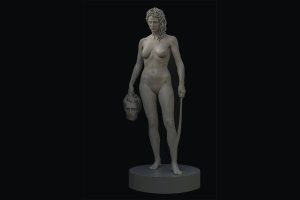
“Medusa With the Head of Perseus” by Luciano Garbati
In many visual depictions of Medusa and Perseus from antiquity, Perseus can be seen in the “heroic nude,” sometimes holding a weapon or cloak, but always holding Medusa’s stone-cold head. These stood as constant reminders of the conquered woman: that once you deviated from the strict rules the patriarchy left for you, you would be punished. And yet, the minute we see their roles reversed, the narrative changes.
Rogers expands on this, explaining that “[m]any of the issues brought to light by these retellings, such as the narrative of victim-blaming and the chilling normalization of the mistreatment of women, are just as familiar to modern audiences as they were back when the original myths were written, as evidenced by modern feminism and events like the #MeToo movement” (3–4). In fact, this sculpture is exemplifies how retelling can play a part in movements like #MeToo, given that she is currently standing in front of the New York County Criminal Court building, where Harvey Weinstein had been tried.
While there is much debate about the sculpture, Julia Jacobs explains that Garbati had wanted to “[conceive] of a sculpture that could reverse that story, imagining it from Medusa’s perspective and revealing the woman behind the monster,” and is this not the quintessence of re-vision? It is the act of reversing the roles, of giving the perspective to someone who has been marginalized or ostracized, and finally giving them the voice they had always been yearning for.
With that in mind, finally, I believe it’s time to tie it all together, don’t you think?
Tying it Together
Classics is an age-old realm of study–and one that I myself am majoring in–and yet it perpetuates archetypes that cause harm to those who read or study it. It begs the question of why we continue to elevate texts like the Odyssey, Iliad, Aeneid, Metamorphoses, and so on, when doing so perpetuates, at least to some degree, harmful perceptions of how women should act and what may happen to them if they deviate from their expected norm. Rogers explains it well, arguing that “these stories are also loaded with misogyny and the objectification and villainization of female characters, and these messages, though not as obvious, are nonetheless passed along to readers and listeners over time” (3). And yet, when framed with this understanding of how these ideas might be passed along, readers and re-visioners can accomplish the exact opposite.
In fact, these myths serve a purpose because it is their feminist retellings—like Natalie Haynes’ Medusa-retelling Stone Blind (2022)—that “work to address this pattern and dismantle the acceptance of these views and the behaviors that go along with them, recasting female characters like Circe, Medusa, and many others, whose stories often involved being sexually assaulted or raped and then punished for the male character’s actions, and giving them an independent voice” (Rogers 3). Medusa, specifically the role she plays in Perseus’s narrative, is already a fairly well-known story, but with the development of stories that alter the narrative, those who think they know Medusa can finally see her in a different light. They can finally hear her story.
Rogers makes additional connections to the value of the retellings of Greek myths and how they serve today’s society: “The very recent wave of retellings of Greek myths through the female perspective . . . are incredibly important narratives to be told, because they too reveal the opportunities for social and political progress that arise from taking female characters from classic Greek myths and giving them the autonomy and voice that they lack in the original versions” (3). Retellings are not only enjoyable good reads, but they serve a purpose as a feminist awakening and a reclaiming of our identities and the identities of the women they are giving voice to.
Let’s finally move on to my favorite part of this discussion, looking at an example of retelling in action.
I would like us to read Dexter’s quotation of Ovid one more time–I know, but please take a moment to read it again, focusing on language, description, characterization, and all that fun stuff.
°¿±¹¾±»å’s Metamorphoses:
“She was most beautiful in form, and the envied hope of many suitors. And there was no part of her more attractive than her hair: I learned that [from someone who] said he had seen her. The ruler of the sea [Neptune] is said to have raped her in the temple of Minerva. The daughter of Jupiter [that is, Minerva/Athena] turned away and hid her chaste face in her aegis; nor was this deed unpunished. She turned the hair of the Gorgon into ugly snakes.” (31)
How might this sound from a modern perspective, the perspective of a woman such as myself? Here is what I ended up with:
My retelling:
“I was always told I was beautiful. And while I admit I did enjoy the compliment when I heard it, when the other Priestesses of Athena told me how alluring my hair was, how soft my lips looked. Oh, how harmless their idle compliments felt! But as I grew older, men paid attention too, and soon it seemed, many of them came to Athena’s altar to admire me like I was some stone statue to marvel at. Soon, those men became suitors, and it was all I could do not to yell, “Please, leave me alone!” But one day, it was not a suitor that came to me, and no power in my mortal vessel could stop him. Poseidon liked what he saw, and he seized it in the one place I thought I was safe. Athena was not happy, no, she was quite upset. I had served her for so long, I thought she would perhaps protect me from further despair, but rather, she pushed harder on my wound. She banished me from that ruined safe haven and took from me the burden of my beauty. I’m still not sure, actually, if it was a punishment after all.”
Do you see how much a little bit of word choice and a modern woman’s perspective can do when changing the understanding of a woman pushed so far into the corner of her own being? I wanted to include my rendition of a retelling both to allow you a fresh perspective and also to show how much word choice, tone, perspective, and modern narration can completely alter the way we understand women. And not just women, but the emotions they feel, and how they can be rendered by someone who may understand her just a little bit more than her male counterpart.
If you’re still wondering what the point of all of this is, allow me to explain: I know I’ve said it already, but women have been written by men for far too long. In so much of myth, female characters are forced into the narratives of men and male perspectives: they have no liberty or ability to be understood as humans with ideas, thoughts, feelings, strength, or just pure rage. They are limited to what was “understood” about them in the ancient world. And, to be completely honest with you, I’ve had enough of it.
Retelling these stories offers a fresh glimpse into what these women may have experienced, from the perspective of women who would comprehend far more what they were feeling compared to the men who originally wrote their stories. They give those women, and the real women that existed during that time, the voice they had always longed for, and in doing so, retellings offer them a legacy, a rebirth. And the readers who discover their retold stories, who listen to that new version, who take it in, become a part of the journey, another step in the dismantling of the male-dominated narrative and act as a conduit for the newfound voices of castaway women.
That is why these retellings are so special, they give women long gone the words they were never allowed, offering a redemptive and beautiful eulogy.
Works Cited
Cixous, Hélène, et al. “The Laugh of the Medusa.” Signs, vol. 1, no. 4, 1976, pp. 875–93. JSTOR, http://www.jstor.org/stable/3173239. Accessed 1 May 2023.
Dexter, Miriam Robbins. “The Ferocious and the Erotic: “Beautiful” Medusa and the Neolithic Bird and Snake.” Journal of Feminist Studies in Religion, vol. 26 no. 1, 2010, p. 25–41. Project MUSE muse.jhu.edu/article/381897.
Haynes, Natalie. Pandora’s Jar: Women in the Greek Myths. United Kingdom, Pan Macmillan UK, 2020.
Hesiod. The Poems of Hesiod: Theogony, Works and Days, and the Shield of Herakles, University of California Press, 2017. ProQuest Ebook Central, https://ebookcentral-proquest-com.elon.idm.oclc.org/lib/elon-ebooks/detail.action?docID=4815605.
Jacobs, Julia. “How a Medusa Sculpture From a Decade Ago Became #MeToo Art.” New York Times, 14 Oct. 2020, https://www.nytimes.com/2020/10/13/arts/design/medusa-statue-manhattan.html?auth=login-google1tap&login=google1tap.
McGreevy, Nora. “Men Have Feared Women for Millennia. Just Look at the Monsters of Greek Mythology.” Smithsonian.com, Smithsonian Institution, 31 Mar. 2021, https://www.smithsonianmag.com/arts-culture/meet-female-monsters-greek-mythology-medusa-sphinx-180977364/.
Ovid. °¿±¹¾±»å’s Metamorphoses: A New Translation. Translated by Charles Martin and Bernard Knox, W. W. Norton & Company, Inc., 1AD.
Rich, Adrienne. “When We Dead Awaken: Writing as Re-Vision.” College English, vol. 34, no. 1, 1972, pp. 18–30. JSTOR, https://doi.org/10.2307/375215. Accessed 24 Apr. 2023.
Rogers, Kylie E. “Why Myth Matters: The Value of the Female Voice in Greek Mythology.” Honors Theses. Honors College (Sally McDonnell Barksdale Honors College), 2021, https://egrove.olemiss.edu/hon_thesis/1727.
Selisker, Scott. “The Bechdel Test and the Social Form of Character Networks.” New Literary History 46, no. 3 (2015): 505-523. doi:10.1353/nlh.2015.0024.
Zimmerman, Jess. Women and Other Monsters: Building a New Mythology. Beacon Press, 2021.
Author Interview: Jo Bogart 
Q. What was your inspiration for writing “Women in Myth and Their Stories Retold: A Beginner’s Guide to Medusa”? Why was this project meaningful to you?
A. This idea of “Women in Myth and Their Stories Retold”’ is something I had been thinking about since I first came to Elon. It had just been a small thought in my head at first, but my advisors and mentors—Professor Chapman and Dr. Meinking—helped me to shave at the surface of that idea, allowing something to take form underneath. Now, not only am I writing my own retelling of a woman in classical literature, but I am pursuing research regarding how women are portrayed in ancient Greco-Roman literature and myth, and the implications of this on society then and today. While Medusa’s story is interesting and important, this piece is just the tip of the iceberg for me. I hope to continue working toward research and scholarship in this field. Embedding my own creative writing into the scholarship makes it especially meaningful to me. I am working to crack open the thick skin of women’s literature and writing, and how writing our own stories awakens a part of what it means to be a female-identifying individual in this world.
Q. Is this your first time working with a beginner’s guide? If yes, what did that learning process look like for you? How has it changed the way you’ll work with writing in the future?
A. I’ve done research essays before in classes, but have never done a Beginner’s Guide, or a piece like this one! The learning process was a difficult one: I had to deconstruct every previous perception I had of what it means to write a traditional research paper. I had to think deeply about my audience, whom in the crowd I wanted to talk to. There were times where I felt like the words for this piece simply did not exist, yet the words did come, and I am proud of what they came together to create. This project has changed the way I see and write research essays. I now ask myself who it is I want to reach and what language I want to use to affect my reader. I will continue to embrace and use my creative writing in my work whenever I can.
Q. What roles did your peers play in developing this project?
A. My peers played a huge role in developing this piece. We had many peer-review days where I received valuable feedback on what I could do differently, and whether they enjoyed the direction I was going, or if it wasn’t working. Having different eyes on your work to highlight things that you may not have seen makes an incredible difference in how well your piece works and whether it is achieving what you want it to.
Q. What advice would you give to students who are currently enrolled in ENG 1100, might want to complete a similar project, or are interested in publishing in Phoenix Rhetorix?
A. First and foremost, talk to your professor! When I told Dr. Lindenman that I wanted to work on this piece with the goal of submitting it to Phoenix Rhetorix, she took extra time out of her day to help me with my project. Your professor genuinely wants to help you, and if they know that you want to pursue Phoenix Rhetorix, they would love to give attention to your piece in order to get it to where it needs to be. I would also argue that the piece you are writing does not have to be something you are pursuing for research, or outside of your ENG1100 class at all, for it to be worthy of publication. As long as you are writing about something that you are interested in or are passionate about, I think it is something that deserves to be seen, acknowledged, and read by others.
ENG 1100 Faculty Interview: Heather Lindenman (she/her) 
Q. During your ENG 1100 class, what about Jo’s piece stood out to you?
A. Jo took a highly creative approach in this piece, fusing creative writing, research, myth, literary theory, and personal reflection. I loved watching Jo’s mind at work! She did not want her piece to be limited to a single genre, and fusing these various approaches together led to a multi-faceted and rich exploration of Medusa and feminism.
Q. How do you see Jo’s piece contributing to Elon’s ongoing conversations regarding diversity, equity, and inclusion?
A. Jo’s piece examines how myths, in this case the Medusa myth, perpetuated negative narratives about women. While some feminists take up arguments against modern-day misportrayals of women, Jo’s exploration shows how even the foundational stories we might not consider relevant today perpetuate similar narratives. She carefully unpacks this through her own creative retelling at the end, which is so cool.
Q. What stood out to you about the author’s work on this project or their approach to the project?
A. Jo totally overhauled this piece multiple times. She began the project with commitment, creativity, and an open mind, and even after she had a complete, complex draft, she reinvented her work based on feedback and her own creative vision. She was always ready to start over, if she needed, and rewrite. I love seeing her interest in classics, feminism, and literature come together in this creative piece.